Coach teachers in and model incorporation of research-based best practices in instructional design when planning technology-enhanced learning experiences. (ISTE, 2011)
One of the most valuable takeaways for me from my SPU DEL program is the formation of a faculty learning community (FLC). This community has allowed me to have insightful conversations with my fellow faculty on how best to design our lesson plans to give our students the best learning experience possible. One of these discussions focused on the group projects we used in many of our courses. Too often, these projects did not really represent the real-world experiences that would most benefit our students.
One of my SPU projects involved improving an existing lesson plan. I used this project as an opportunity to solve the issue brought up in my FLC in group projects. Specifically, I wanted to re-design my course using the understanding by design process that we covered in my SPU masters program. In this process, the educator starts with identifying the desired results. This is the very thing that my FLC conversations suggested that we did not do well in our existing lesson plans, as most of us start out by diving directly into building the lesson plan. From these desired results, you determine acceptable evidence that students had achieved the desired results. It is only after completing these first two stages that you start the process of planning the student learning experience and instruction. The authors Wiggins and McTighe refer to this process as the ‘backward design’ approach.
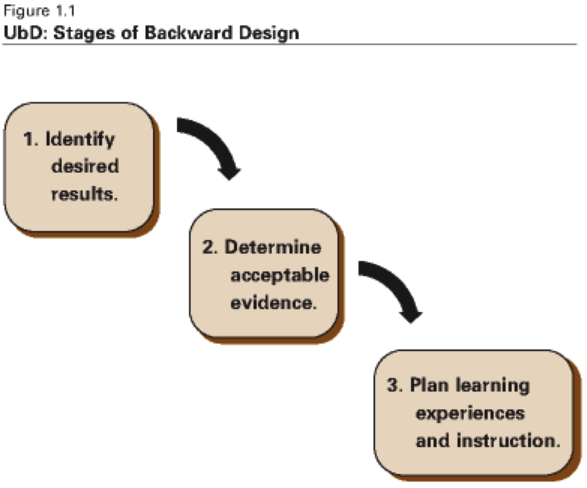
I discussed the backward design approach with my FLC. The first issue that the FLC recognized in using the backward design process in our group projects is how to make the work manageable. Many of our group project ideas would not fit the timeframe of a typical assignment. We came up with a solution in which we start the group project at the very beginning of the course, and have checkpoints throughout the course. This made the work more manageable while also allowing project ideas that were achievable. One faculty member suggested another option of dividing up a more complex project into multiple pieces, and have different student groups work on the different pieces. I have applied the first approach in my JavaScript course and come aways with results I am eager to share with my FLC. Similarly, I am eager to hear from the other FLC member who took the divide and conquer approach.
References
- International Society for Technology in Education. (ISTE; 2011). Standards for Coaches. https://id.iste.org/docs/pdfs/20-14_ISTE_Standards-C_PDF.pdf.
- Wiggins, G., & McTighe, Jay. (2005). Understanding by design (Expanded 2nd ed., Gale virtual reference library). Alexandria, VA: Association for Supervision and Curriculum Development.