Coach teachers in and model effective use of technology tools and resources to systematically collect and analyze student achievement data, interpret results, and communicate findings to improve instructional practice and maximize student learning. (ISTE, 2011)
One of the phrases that I heard repeatedly when I worked in the computer science industry is “you get what you measure”. For example, if you want a product that has high customer satisfaction, then you have to figure out how to measure customer satisfaction, and then collect and analyze the data. It is hard to achieve some goal if you have no supporting data or do not analyze the data.
This holds true for education as well. An institution has to decide on the goals for learning. If an institution wants to provide students with the best learning experience, the institution has to figure out how to measure student’s learning experience and analyze the data. In my post on designing courses and analyzing the results, I mention that my institution uses Tableau server to store results from student surveys on their learning experience as well as metrics like enrollment. One of the questions in the survey asked students why they are attending the college.
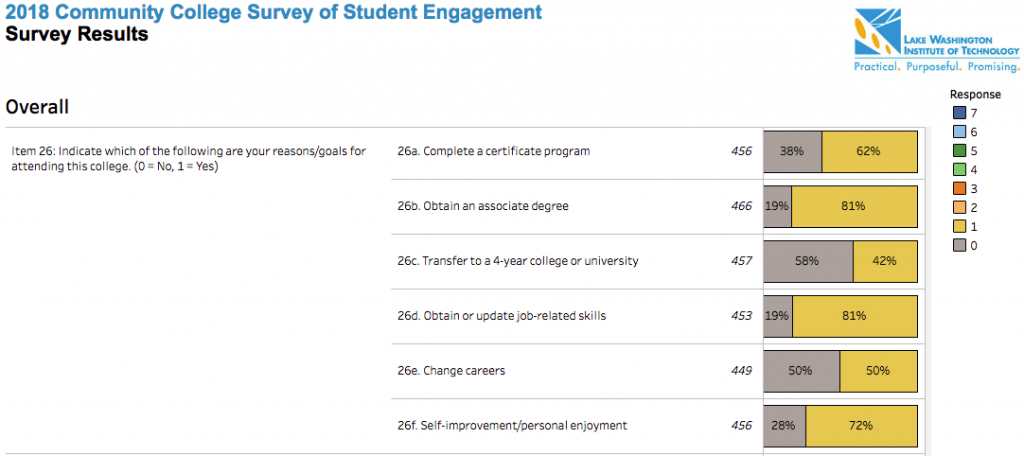
This question is particularly relevant to my Computing and Software Development (CSD) department as we were in the process of introducing a 4-year bachelor’s degree in addition to the already available 2-year associates degree. The faculty asked the dean and chair of the department for how we should focus the lesson plans for courses in each of the two degrees. The consensus resulted in making courses for the 2-year degree more focused on breadth of learning, as these students wanted to pass the entrance exams for the computer science department of a 4-year college like the University of Washington. The 4-year degree students are more focused on getting a job at the end of their studies, and that we should focus more on the skills that would make students successful in the software industry.
However, if you look at the question above, you’ll see that there are some students that are not following this model. Specifically, question 26b shows that 81% of the survey participants wanted to obtain a 2-year associates degree, while question 26c shows that only 42% of the survey participants want to transfer to a 4-year college or university. Furthermore, question 26d shows that 81% of the survey participants want to obtain or update job-related skills. The results indicate that students in the 2-year associates program were as interested in obtaining job-related skills as the students in the 4-year bachelors program. These results have been useful in my conversations with education leaders and administration at my school when making changes in course curriculums. For example, rather than just leaving instruction about the full software product cycle to bachelor’s program, we would include this instruction in the associate’s program as well. These changes would better align with the goals that students expressed in the student satisfaction survey.
References
- International Society for Technology in Education. (ISTE; 2011). Standards for Coaches. https://id.iste.org/docs/pdfs/20-14_ISTE_Standards-C_PDF.pdf.
<< Previous: 2G Next: 3. Digital Age Learning Environments >>